
When buying a home with a mortgage loan, it’s essential to understand the costs you’ll be responsible for. One of those expenses may be mortgage insurance. Let’s take a look at what mortgage insurance is and how it works so you can make an informed decision during the homebuying process.
What is mortgage insurance?
In most cases, the process of buying a home involves taking out a mortgage and making a down payment. With a conventional mortgage, which is a home loan that isn’t federally guaranteed or insured, you have to pay for private mortgage insurance (PMI) if you put less than 20% down.
With an FHA mortgage backed by the U.S. Federal Housing Administration, you’ll pay for mortgage insurance regardless of the amount of your down payment.
Mortgage insurance isn’t required with USDA mortgages backed by the U.S. Department of Agriculture and VA mortgages backed by the U.S. Department of Veterans Affairs. However, there are fees to protect lenders in case borrowers default. So you may still be responsible for the extra cost of these home loans in exchange for the low down payment requirement.
Be sure to ask your mortgage lender about your available options for mortgage insurance when shopping for a mortgage loan.
How does mortgage insurance work?
As the borrower, you pay the cost of mortgage insurance each month, although you are actually paying to cover the lender. If you fail to make mortgage payments, your lender will receive payments from the mortgage insurance provider. You are still responsible for repaying the mortgage loan.
Private mortgage insurance vs. mortgage insurance premiums
Mortgage insurance comes in two forms: private mortgage insurance (PMI) and mortgage insurance premiums (MIP).
Conventional mortgage borrowers with a downpayment of less than 20% pay private mortgage insurance. Depending on the borrower’s credit score, the PMI rate will increase or decrease. PMI rates are often lower than MIP rates. Most of the time, PMI is part of your monthly payment and involves little or no initial payment amount at closing.
FHA borrowers pay mortgage insurance premiums instead of PMI. The MIP rates will not vary with the borrower’s credit score but will be lower for borrowers who can pay a downpayment higher than 5%. A MIP payment is due upfront at closing and then with each monthly mortgage payment after that. With MIP, there is also an annual fee the borrower must pay.
How much is mortgage insurance?
With PMI, you can expect to pay an amount equal to .05% – 1% of your home loan. With a MIP, you can expect a payment of 1.75% of your home loan.
Your downpayment is the most significant factor that affects how much PMI you will pay. Still, other considerations come into play, such as:
- The PMI type (see more below)
- Type of mortgage interest: fixed or adjustable
- The length of the mortgage term
- The loan-to-value (LTV) ratio
- The amount of insurance required by your lender
- The borrower’s credit score
- The home’s appraised value
How to calculate mortgage insurance
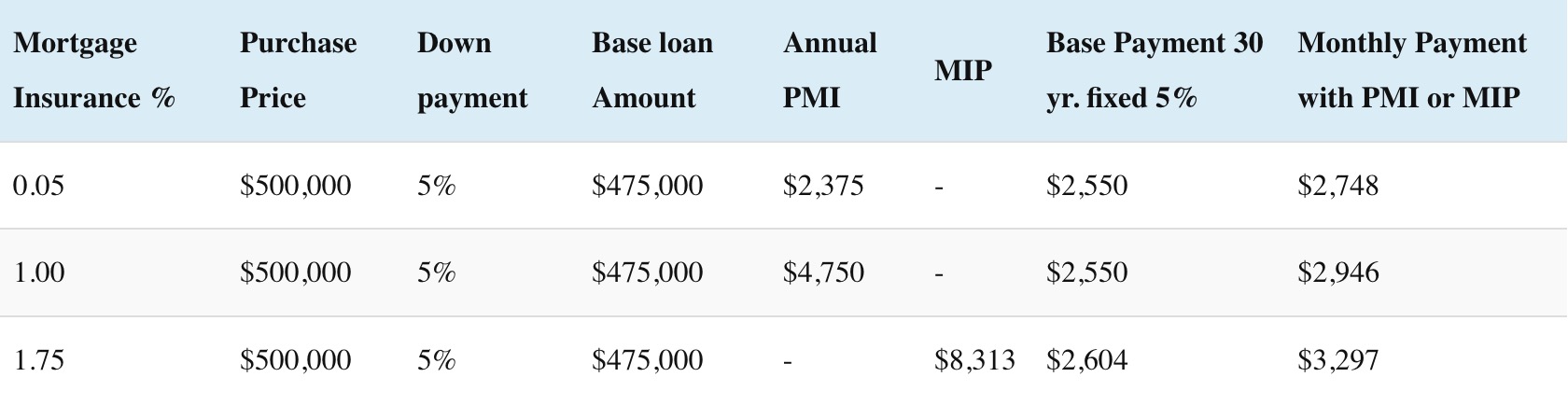
As noted above, PMI rates vary from .05% – 1% of your home loan. For MIP on an FHA loan, the rate is typically 1.75%. Here’s how payments break out on a $500,000 home with a 30-yr —fixed-rate loan at 5%.
Types of private mortgage insurance (PMI):
Each type comes with its own advantages that suit various situations. Choosing the right one can put you in an ideal home buying position.
Borrower-paid mortgage insurance (BPMI)
This is the most common type of PMI, paid monthly along with loan payments. Typically, borrowers will pay .5% – 1% of their loan amount per year for PMI. For a $500,000 house, this comes to $2,500 – $5,000 per year, or an additional $208 to $417 each month. With borrower-paid PMI, you pay BPMI every month until you have 20% equity in your home (based on the original purchase price).
Lender-paid mortgage insurance (LPMI)
With lender-paid PMI, rather than a monthly PMI payment tacked onto the mortgage payment, the borrower pays a higher interest rate or mortgage origination fee to arrive at the amount required for insurance, in effect paying the lender indirectly. The lower the borrower’s credit score, the higher their interest rate. In this way, the lender is more secure in the loan. The LPMI rate typically adds .25% – .5% to the interest rate. LPMI is a good option if you want a lower monthly payment or qualify for a larger loan. The downside with LPMI is that even if you reach 20% equity, your interest rate will not decrease unless you refinance.
Borrower-paid single premium mortgage insurance (SPMI)
This payment type is possible if you have some extra savings and want to cover your PMI upfront. In this case, the borrower will make one upfront PMI payment at closing or finance it into the loan. Upfront payment will result in a lower monthly payment. Any lump-sum payment is non-refundable. Unlike home or auto insurance premiums, mortgage insurance premiums will not be prorated and refunded if you decide to refinance or move after a couple of years.
Split-premium mortgage insurance
Split-premium mortgage insurance is the least common type – it’s a combination of BPMI and SPMI. You pay part of the mortgage insurance as a lump sum at closing and part monthly with this option. You don’t have to come up with as much extra cash upfront as you would with SPMI, nor do you increase your monthly payment by as much as you would with BPMI. One reason to choose split-premium mortgage insurance is if you have a high debt-to-income ratio. When that’s the case, increasing your monthly payment too much with BPMI would mean not qualifying to borrow enough to purchase the home you want.
Unlike the interest on your home loan of $750,000 or less, PMI payments are not tax-deductible.
Mortgage insurance premium (MIP)
This type of mortgage insurance is for FHA loans. There’s only one type of MIP for FHA loans, and there is no lender-paid option. The borrower pays a portion of the premium upfront at closing and continues to make a monthly premium payment. Plus, borrowers pay an annual MIP payment. The yearly MIP payments are approximately .45% – 1.05% of the base loan amount.
In most cases, the borrower pays mortgage insurance for the duration of the loan term unless their downpayment is 10% or more, in which case, the lender would remove MIP after 11 years.
How long do you need to have mortgage insurance?
The length of time a borrower will need to have mortgage insurance will depend on their loan type and down payment amount. A conventional loan with less than 20% down will require PMI until 20% of the loan is paid off. At that point, the borrower can request the removal of the PMI.
PMI does eventually end in most cases.
Once the mortgages LTV ratio drops to 78%—meaning your down payment, plus the loan principal you’ve paid off, equals 22% of the home’s purchase price—the federal Homeowners Protection Act requires the lender to cancel the insurance automatically.
In contrast, MIP remains an obligation for the loan’s lifetime unless the borrower makes a downpayment higher than 10%. In that case, the borrower would pay MIP for 11 years.
There are a couple alternatives to paying PMI on a conventional loan
Piggyback loan
A piggyback loan helps a conventional borrower avoid PMI. In the case of a piggyback loan, the borrower takes out two loans. The first loan will cover 80% of the purchase price, and the second loan will cover between 10-17% of the home sale but at a higher interest rate. The borrower will then need a 3-10% down payment with a piggyback loan.
Piggyback loans are also called 80/10/10 loans. Because the borrower applies for two separate loans and the overall payment amount may be more expensive. Compare and break down the actual quotes to see if a piggyback loan is suitable for this situation. With this loan method, the borrower will pay back two separate loans.
Down payment assistance programs (DPA) or closing cost assistance
Your state or local government may have special programs to help first-time homebuyers avoid PMI. Requirements typically include completing a homebuyer education program, which could help you qualify for downpayment and closing cost assistance and avoiding PMI. Check with your local government to see what programs are available before you apply for a mortgage – your lender should be able to direct you to any such resources. There are more than 2,000 DPA and closing cost assistance programs nationwide and DPA programs do vary by location.
A final word on mortgage insurance
The type of mortgage insurance, the length of time you’ll need to pay, and your insurance rate will all depend on the type of mortgage loan you’re applying for and your unique financial situation. When shopping for a mortgage loan, ask your lender about the various mortgage insurance options available and the associated costs.

Leave a Reply